













Application of Ultraviolet LED


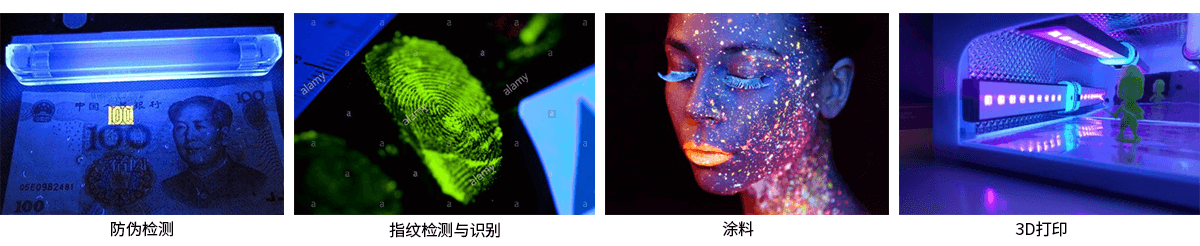
UVA band: Mainly applied in the ink, coating, and optical glue curing process. Wavelength is the key factor affecting the UV curing effect. Basically, the shorter the wavelength is, the higher the absorption rate. Therefore, UVA ultraviolet with a shorter wavelength is often applied in surface curing fields such as inks and coatings, while that with a longer wavelength is often applied in stereo curing fields such as 3D printing.


UVA-LED application scenarios: 


UVB band (280~315nm): Compared with UVA band, UVB band has higher energy and therefore important applications in archaeology, biology and medical fields, such as UVB ultraviolet phototherapy application. It can accelerate skin metabolism and improve skin grow power, thus effectively treating leucoderma, pityriasis rosea, polymorphous light eruption, chronic actinic dermatitis, photo linear prurigo, and other photodermatoses. In addition, ultraviolet catalysis is also one of the application forms of UVB ultraviolet. The pollutant removal is realized through the redox ability based on a photocatalyst and under ultraviolet irradiation, such as degradation of harmful substances in a substrate culture nutrient solution in soilless culture and removal of NOx and Sox (main source of PM2.5) in the automobile exhaust.


UVB-LED application scenarios:


UVC band (100~280nm): The ultraviolet band with the wavelength from 200nm to 280nm belongs to the UVC band. This band can break the hydrogen bond of DNA base pairs in a very short time, cause the growth cell death or regenerative cell death, so it has an extremely broad application prospect in air purification, sewage treatment and other fields involving sterilization and disinfection functions, such as hospital/medical equipment, air conditioning system, disinfection cabinet, water treatment equipment, water dispensers, sewage treatment plant, swimming pool, food, and beverage processing and packaging equipment and other fields. According to the research, the most effective sterilization band is from 250nm to 270nm. After long-term research and verification, UVC ultraviolet light can kill bacteria, fungi, spores, and viruses in a short time, with the removal efficiency up to over 99.99%. As UVC band sterilization and disinfection is a pure physical sterilization method, it is featured by high efficiency broad spectrum, rapidity, and completeness, no need to add chemical agents, no drug resistance, no secondary pollution, etc.


UVC-LED application scenarios: